Monday, November 19, 2012

Ugly Bug Ball

So, I don't know how you all are planning to spend your Thanksgiving breaks, but I'll be searching for true love....Ugly Bug Style!

More subtle childhood inspiration for Entomology:
Note: the drawing board brings us For-mic-i-dae, Hy-men-op-tera. Better known as, Ugly Bug!

Wednesday, November 14, 2012

Woolly Aphids

Hey everyone! I've identified an insect family for you! Woo! (Well, maybe. I have to look at it under a microscope to double check. But this could be right... maybe)!

Remember that one time in East Rock, when we saw a tree branch that seemed to be colonized by a whole bunch of fluffy white stuff? And then, after Rich's suggestion, we--the n00bs that we were--collected some of the fluffy insects, excited to get hold of a "different family." They looked sort of like this:

Image source: https://blogger.googleusercontent.com/img/b/R29vZ2xl/AVvXsEjip_JT06hypNZvxlAwrCBuQ-Je1LBLJmaB1QZD3aAyigEKoes-1nZM2K66YKdbaxDkepJVzZJ20Jtdt94VHKL0dMHr6HFz7FEsLzgsHU6E2h1__qCLD1iCr8varndmElB4Utt_OGctsiA/s400/fagr3028.jpg

If I am not mistaken, these are probably woolly aphids from the Eriosomatinae subfamily (Order: Hemiptera, Suborder: Sternorrhyncha, Family: Aphididae). One of their common names is "fairy fly" because of the way they fly. They initially don't use their wings, allowing the wind to carry them by their waxy streaks, so they just drift in synchrony with the wind like plant seeds, until they are ready to use their wings and direct their flight. 

Woolly aphids get their fluffy appearance from a wax they produce in very long, thin streams. If you wash a woolly aphid in a wax-dissolving substance, you will see an ordinary-looking aphid underneath.  The wax protects the aphids from predators while they feed because, although it is visible, it is often mistaken for mold or fungus, which no predator wants to eat. The adults are winged and move to new locations where they lay egg masses. Up close, they can be really cute:

Image source: http://www.pbase.com/tmurray74/image/34892806

As we know, aphids are sucking insects and, as, Hemipterans, have piercing-sucking mouthparts to penetrate the thick plant matter they eat and suck up the liquid contents. Woolly aphids withdraw sap from the plant matter they pierce, which can be leaves, buds, twigs, bark, and even plant roots. From feeding on this sap, they produce a sweet, sticky substance known as honeydew, which often coats leaves, bark, and objects beneath the tree, giving them a wet, shiny appearance. But regular Aphids use their cornicles on the dorsal side of their abdomens to deposit honeydew. You will only find reduced or absent cornicle structures in Erosomatinae. 

Anyway, you should probably still look at your specimen under the microscope because I haven't yet, and at this point this is all still speculation. But at least now you know a little bit more about fluffy white stuff you find in nature.

Sources (really weak - there have to be better woolly aphid sources online)!
http://www.extension.umn.edu/yardandgarden/ygbriefs/e453woollyaphid.html

http://www.journal-news.net/page/content.detail/id/580213/Woolly-aphids-are-more-than-floating-seeds.html?nav=5067


Tuesday, November 13, 2012

One thing I try to do in my painting studio is to mix "unnamable colors," colors that can't be described as mere red or bright red. Many biological colors are unnamable. For example, human skin has so many colors other than just the "skin color:" bluish light-brown, pinkish dark-brown, orangish medium-brown, etc. So for my painting I decided to get colors from larva. I sent an email to Marta to ask whether she had some actual colored specimens that I could see, but unfortunately larva lose colors when they are preserved. So I ended up color-printing photos from Google search.


With the photos on my studio wall, I begun mixing the "larvae colors" from the colors I already had. Mixing colors is not an easy process, especially when it gets to making unnamable colors. For example,  to make the following color I had to mix: purple, primary yellow, titanium white, raw umber, dark gray, quinacridone magenta, dioxazine purple, and little bits of colors that I don't remember. After 7 hours of struggle with the larva photo, I ended up with 20 larva colors.

With these colors I made my painting.


It's an interesting idea that by simply mimicking the colors of larva one can recreate the physical properties of larva in an entirely different form. My next goal in painting is to use these larva colors to create a sensual feeling of "finger-poking the larval abdomen."

Sunday, November 11, 2012

The bugs are out again!

In todays delightful weather, I decided not to do any studying (terrible idea) and go hike up east rock (awesome idea).

Turns out the bugs are back!  I didn't bring my net (sad day) but caught a lot using the very scientific stick your hand in its flight path and make it land method.   I found two really awesome mini coleopterans, a siricid wasp (which I unfortunately couldn't catch) some little bluish gnats, and many others.

Get out there tomorrow!  Bring nets!

Thighsofsteelblatella: A new genus of cockroach!

A cool paper was just sent to me by a South African biologist friend.  Some researchers discovered a new species of cockroach, which is in itself not newsworthy, but this one jumps.  In fact, it spends most of its time jumping.

Saltoblatella montistabularis looks and moves quite a bit like an orthopteroid, but the segmentation and general morphology is clearly cockroach-like when you look closely.  It jumps by (you guessed it) rapidly extending its flexible hind tibiae.  They can make it pretty far- up to 48 times their body length on one jump.  There are many ecological reasons that suggest why this developed (tall grass, etc).

But more importantly:  Jumping is generally thought of (according to this paper) as having deep evolutionary roots, but not much of this roach's anatomy has been heavily modified.  Grasshoppers, springtails and other famous jumpers have very specific, complex and well-developed mechanisms for jumping.  This roach uses mechanisms for jumping that are relatively small modifications of existing structures.

A bit of searching through the fossil record turned up evidence that jumping may have evolved a long time ago in blattodea, but not resulted in adaptive radiation.

This begs the question (and has me really curious)- what is this roach's phylogenetic affiliations?  Is it part of an ancient and limited lineage?  Did jumping develop and disappear throughout Blattoidea over time?  Or is this just a roach that recently developed thighs of steel?  I'm gong with the first option, but  the jury seems to still be out.


Full text of the article with **Really Cool Pictures*** (free access provided by Yale, whatupp):
http://rsbl.royalsocietypublishing.org/content/8/3/390.full.pdf+html

Wednesday, November 7, 2012

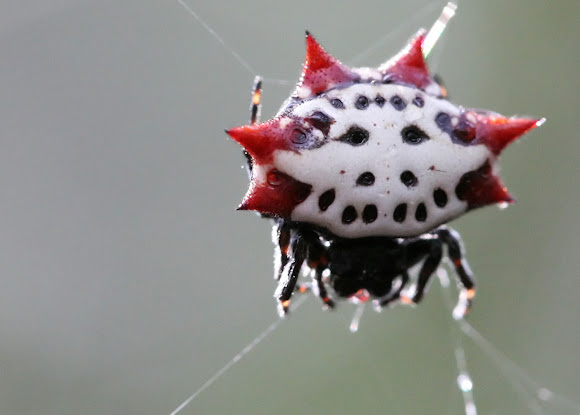
Spiny Butt aka Spiny Orb Weaver

Here is a post I forgot to publish earlier this week!

When I got back from Florida, one of my friends asked me what was the coolest spider I found. I quickly answered the "spiny butt spider." She did not look impressed at the name we had given it, so I explained that it had a spiny butt and was cool and had a really circular web! She still did not look very impressed. I decided to do more research and here is what I found out:

The spiders we collected in Florida are from a genus of spider called Gasteracantha or by the common name "spiny orb-weaver" (which is not very different from what we were calling them!). They are smaller than most other orb weaver spiders and can reach sizes of up to about 33mm. The bite of a spiny orb weaver is harmless to humans and they are considered a nuisance only when the build their webs in a heavily populated location. These spiders also generally have a brightly hued abdomen (white, yellow, and orange are common). The most distinguishing feature of the spiny orb weaver are the six spines poking out of its back.


The different colors of the spiny orb weaver

Another colloquial name for the spiny orb weaver is the "crab spider" since its abdomen looks much like the shell of a crab. However, this name is misleading since it is distantly related to the crab spider family Thomisidoe. The orb weaver also spins a distinctive flat, round shaped webs in shrubs and trees.


Web of a Gasteracantha cancriformis 


The most common species of spiny orb weaver is Gasteracantha cancriformis and this is the species we found in Florida. This species is common in the United States along the southeast coast as well as parts of California.


I now feel very informed about the spiny orb weaver! 

Here is a really dramatic (but not well informed) spiny orb weaver video:
http://www.youtube.com/watch?v=veXlzQk9bUA


Monday, November 5, 2012

Don't Mess with Moose Botflies

Here's a command:

Maybe you're a Bing enthusiast, or you're still into Ask Jeeves! I, for one, do not mind the monopoly that is Google over the internet. Whatever the case, go to your usual search bar and type in "moose botflies." You will find a slew of unpleasant article titles, such as

"Swedish Insects Shoot Larvae Into Victim's Eyes"

and

"Fly shot maggots into woman's eye"

Unpleasant? Yeah.

Moose bot flies fall into the larger category of nose and pharyngeal bot flies, which are obligate parasites whose larvae inhabit the nasal, pharyngeal and throat cavities of various mammals. Though they come in several different host-specific species, ranging from cervids (deer) to horse to sheep to caribuou, their parasitic effects on mammals are huge. Mammals that are parasitized by these nose or pharyngeal botflies tend to be heavily infected, and have high mortality rates. However, in some cases, the larval population inhabiting the host is small, and does minimal damage to the host.

The moose botfly, or Cephenemyia ulrichii, sometimes also called an elk botfly or moose nose botfly or moose throat botfly, enters its mammalian reservoir as a third instar. After mating, the adult female moose botfly seeks a host for her offspring. She usually looks for the mucosal insides of moose and other cervid pharyngeal passages. When she finds the target for her already hatched larvae, she shoots the larvae at the host animal's nostrils. The larvae then travel into the nose as they feed on the mucus. From there, the larvae wriggle down to the throat where they reach their third stage of development.

Sometimes, humans are the unlucky targets of female moose botflies, and they shoot their larvae into the eyes of humans who are casually strolling in the woods. Swedish scientists suppose that, when this happens, the female botflies mistake human eyes for the moose nostrils. The sensation has been described as the feeling one gets when "slapped in the face by a branch." Larvae can only make it to the second stage of development in humans, which means that adult female botflies are making poor life decisions when they choose to shoot larvae in our eyes. But we should still know to watch out--pain and conjunctivitis (eye infection) are likely to result from attacks by these guys.

Weirdly, I could not find a video of a moose botfly shooting larvae into a host's nostrils. Someone's gotta film that so I could watch it and send it to you!