Friday, October 12, 2012

Assortment of Random Arthropod Links 1

This will probably happen more than once on this blog per semester (and hence why I've titled this with "1"). I've been loading up the "Drafts" folder with stuff I've been meaning to post about, but it's gotten out of hand, and I think it would be more productive to post all of the arthropod links at once instead of parsing them all out. So, here's a bunch of stuff I found worthy of a blog post, but didn't necessarily feel were worthy of their own stand-alone posts.

1) http://bugasalt.com/

This website is dedicated to the sale of a salt gun for killing insects within short-range (about 3 feet). The gun prides itself on delivering a dead bug that will still be intact and "easy to clean up" (see FAQ page). Basically, the salt gun uses just a pinch of table salt as its ammunition to aim at unwelcome arthropod guests, especially mosquitoes and flies but also roaches and wasps.

On the order page, you can get this nifty device for a mere $34.95 if you're a lone gunman, or 144 guns for $2,800 (price per gun goes down to $19.44 [yes, I calculated that for you]). Doesn't sound too shabby!

Also, if you're not actually too fond of this device but you still want the thrill of killing flies, go on their website and you'll find a fly flying all over the page, which you can ultimately aim, target, and shoot with the simply click of your mouse.

2) Would you be happy or sad if you found this surprise in your raspberries?
I kind of wish those were my raspberries.

3) Amazing Arthropod Photography by Thomas Shahan 
Desktop background quality "macro" photos of arthropods. This guy takes some fantastic pictures of arthropods in their natural habitats. Definitely take a look--these are amazing.

4) Peacock Spider Gets Down For Love
If only I knew how to mate as well as these peacock spiders, I'd be quite the reproductively successful woman. If you click the link above, you'll find a video of the courtship behavior of this "peacock" spider with a link to a pdf of a preliminary description of the species and an undescribed genus Maratus to which it, as well as another undescribed species from 1931 member to the Peckham collection at the Harvard Museum of Comparative Zoology, belong. Cue Katy Perry's "Peacock"...

5) Fashionable Jumping Spiders
This is a link to a series of macro photographs of jumping spiders that carry a water droplet atop their heads, which reflect the scene around them. My question to you people: real or not real? If you don't think so, I suggest you drop by the photographer's portfolio website and see for yourself.

6) Last, but, DEFINITELY NOT LEAST: Beetles as Jurassic Park People
THIS IS THE MOST IMPORTANT THING YOU WILL EVER CLICK 

AND IF YOU DON'T CLICK IT

JUST LOOK HERE


And.... that's all for now. Have a great weekend, everyone!

Thursday, October 11, 2012

Today was the best day ever!

These pictures will tell you why.

1. First, Rich liked my photo submission for a sandwich contest.


2. Then, Val liked my photo submission for a sandwich contest.

3. Then, later, I saw Rich at the gym. A not-so-good part of my day was when he rejected my offer to spot him for bench press. So I decided to put my feelings into action, and...

4. When Rich was doing pull-ups, I snapped a picture of him without him noticing. =]

5. Now, I'm posting this blog entry, and giggles are all around.

Wednesday, October 10, 2012

Fire Ant Shenanigans

As Chelsea has reminded us, the internet is an endless source of arthropodal entertainment, and after being rewarded for timeliness today, I couldn't resist a post when I stumbled on a story regarding our beloved petioled Hymenoptera--the Formicidae! In particular, today we're discussing the genus Solenopsis, denoting fire ant, with nearly 300 species worldwide.

The excitement stems from an April 2011 discussion in National Geographic following a Georgia Tech study. They examined community physical dynamics of these tiny but powerful specimens, particularly in relation to water.

Not only can they form rafts that allow them to survive on water...
This is a pile of 500 experimentally floating (source)

...they can also BECOME water!
Here they are acting like tea. 
I suppose in the crisp autumn air, this beverage really would warm you up.

According to the article, the "team found that fire ant clusters act like fluids with predictable physical properties: A cluster is a fifth as dense as water but has ten times the surface tension and is ten million times more viscous."

Regarding the rafts, a single fire ant was indeed able to walk on water due to its low weight and water surface tension, but interestingly the raft was found to have 30% more 'water repellency.' The photos even show the researchers pushing down on the raft with a stick and the ants holding on--particularly to each other--and staying afloat. 


On a separate note:, these guys are serious:

Enjoy a video of a swarm of fire ants taking down a dragonfly (screenshot above). Earlier in the clip is a somewhat graphic depiction of an earthworm's demise.


100-Million-Year-Old Spider Attack Found In Amber

EVERYONE, THIS IS HUGE!

As of two days ago (on October 8, 2012), the first ever fossil evidence of a spider attacking prey in its web was discovered! Yes, there have been fossil documentations of spiders around this time, the earliest fossil dating around 130 million years ago. However, no fossil evidence has surfaced to give us any indication of social behavior in ancient spiders until now! The juvenile spider's assault has been preserved with remarkable detail by tree resin that flowed over the event in the Early Cretaceous between 97-110 million years ago! This is the era of dinosaurs! Take a look:

Image source: http://oregonstate.edu/ua/ncs/archives/2012/oct/fossil-ancient-spider-attack-only-one-its-type-ever-discovered

The amber captures two ongoing engagements on the silk web: 1) between male spider and its ensnared parasitic wasp prey (above) and 2) between male spider and Neuropteran (image below). (Poinar and Buckley 2012). 

Image source: Poinar & Buckley 2012


The spider has been described as a member of the family Nephilidae and (new) genus Geratonephila, and within that genus has been named burmanica, so G. burmanica is its binomial nomenclature name.  

The wasp has been placed in family Platygastrida and (new) genus Cascoscelio. After a very involved diagnosis, the species was binomially named Cascoscelio incassus ("Casco" is from the Latin 'cascus' for old). 

The fact that a male and juvenile are present in the same web implies the presence of a female since extant nephilids live in female webs, as seen in the image below. Having a web occupied by both a juvenile male spider and a female maximizes the productivity of the web: the spiders living on the web can cooperate to get food and build the web. However, the spiders must be able to get along to share a living space. The presence of the juvenile spider indicates that intraspecific aggression and cannibalism were maintained at a minimal level, which are characteristics of social spiders. (Poinar and Buckley 2012).
Source: Poinar and Buckley 2012

Silk was also traceable in the amber fossil. At least 15 unbroken strands extend throughout the entire length of the amber piece. There are "major" strands (1.5-2.0 micrometers in diameter) criscrossed with numberous thinner strands (0.5-0.7 micrometers in diameter). The web is adhesive, which we know because of the lepidopteran scales and other captured insects as well as the "variously sized viscid droplets." The viscid droplets are covered with aerial plankton (pollen, spores and dust particles), which suggests that the nephilid spider did not rebuild its web at frequent intervals. This would be a similar pattern of behavior seen in extant nephilids.

Yours in sometimes providing relevant information,
Chelsea

Sources
"Fossil of Ancient Spider Attack Only One of its Type Ever Discovered." OSU College of Science. 8 October 2012. <http://oregonstate.edu/ua/ncs/archives/2012/oct/fossil-ancient-spider-attack-only-one-its-type-ever-discovered>.


Poinar, G. & Buckley, R. 2012. Predatory behaviour of the social orb-weaver spider, Geratonephila burmanica n. gen., n. sp. (Araneae: Nephilidae) with its wasp prey, Cascoscelio incassus n. gen., n. sp. (Hymenoptera: Platygastridae) in Early Cretaceous Burmese amber. Historical Biology. 24(5): 519-525.


Tuesday, October 9, 2012

Arthropods as Food News

Friday night, Calhoun College had its annual "Trolley Night" dance, which is supposed to be a New Orleans and Mardi-Gras-style celebration. Why we do it in October and not in March when Mardis Gras comes around? I have no clue.

Anyway, it's a New Orleans celebration, so our pre-Trolley Night dinner appropriately involved New Orleans-themed cuisine. They say that crawfish is a big deal down there, appearing in étouffé and gumbos and oftentimes just plain broiled form. We had the broiled form that night:

Appetizing? See, normally this would have tasted fantastically, appealing to my tastes for rare dining hall food forms (we never get to taste Decapoda meat!), delicacy, and crustaceans. However, something was just off. My "disgust" senses were set off when I touched the crayfish with my tongs. I did not want to eat them! I was so skeeved out after having dissected the preserved crayfish in lab a week and a half ago. Does this happen when you dissect arthropods/anything in general? I was so sad to not be able to experience the delectability that I know crayfish has to offer. 

But, I suppose this novel disgust reaction is probably a good thing. In other arthopods-as-food related news, apparently a 32-year-old man Edward Archbold  just died in a bug-eating contest to win a $850 python in Deerfield Beach, Florida. He collapsed after eating 30 roaches, 30 worms, and 100 millipedes, and then he died later in the hospital. (Source 1, 2). No one is sure of the exact causes of his death, but it probably has something to do with the fact that he consumed an unhumanly amount of bugs. Just maybe.

Though I should add that it is, apparently, safe to eat roaches. There were another 20-30 participants in the competition, all of whom were totally fine (though, he had consumed the most bugs out of all of them). Thus far, no autopsy results on Archbold have revealed the cause of death, and there is only speculation surrounding the tragedy. It has been supposed that he "hit tolerance level for cockroach toxins" (CBS News). The fact that he was the only person to be affected by the roaches suggests that something was up with his physiology. Severe reactions to consuming roaches is rare.

If you want to see the video of this epic battle to the death, click here: http://www.youtube.com/watch?feature=player_embedded&v=QbAmDujNXjs#!. 

There were some pretty insightful YouTube comments. I will draw your attention to one potential zoologist who noted the arthropodal connection between lobsters and roaches:

Others are using this video as an excuse to make sweeping generalizations about countries and their people (notice the two "thumbs up"),

And still others are taking a moment to make tasteless puns.

So, as you can see, this video has inspired rich discussions about a range of topics, from socio-cultural phenomena to terrestrial arthropods, all laced with some killer bug puns when they are most appropriate.

Yours in always delivering only the most tangentially relevant information,
Chelsea

Butterfly Bonanza at Lighthouse Point!

Want some cool lepidoptera?  Here's a hot collection tip:

Last week, right before the beautiful weather turned God-awful, I went to Lighthouse Point Park in East Haven. It's on the Eastern edge of New Haven Harbor, easily accessible off Townsend Ave (take a right on lighthouse road, ignore the check-in booths in the off-season).  It's famous for hawk migration, and right now is in fact peak season if you want to go see some eagles, falcons, and vultures (albeit at some distance).  But the butterfly spectacle that unfolded while I was there beat any insect-related event I'd seen before.

1,100 Monarchs.
200 Painted Ladies.
2 Black Swallowtails.
100-350 Skipper spp (small, so difficult to group-count or estimate group densities)
8 Common Buckeyes.
A handful of Red Admirals.

Birders tally sometimes tally migrating hawks by counting individuals in a cluster or fraction of a group, and multiplying out to get a sense of the full scale.  This is probably a useful simple strategy for insects as well.  For example, the monarch count breaks down to about six bushes with roughly 75 monarchs, eight with about 40 on them, and about 330 in groups milling about or migrating down the coast.

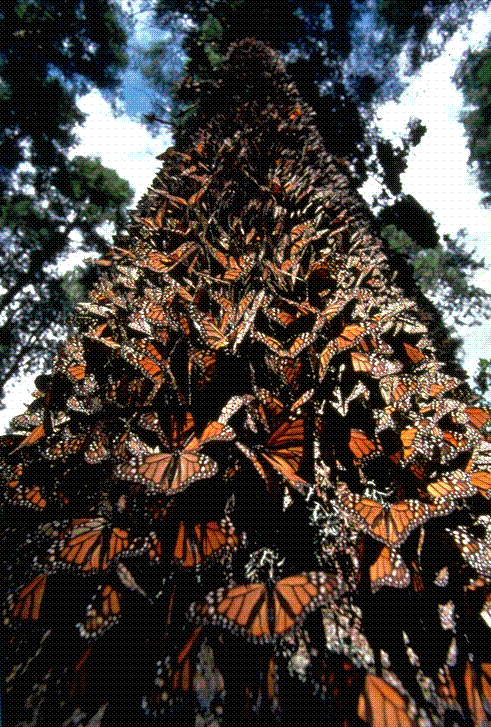
All of these Monarchs were on their way to Oyamel Fir forests in and around Michoacan and DF, Mexico, where they will gather in even more incredible densities- often tens of thousands to a tree.  They live for a few weeks each and migrate north over several generations in the spring, but then produce a "methuselah generation" that marathons all the way back to Mexico. In the mean time, they rely on stopover points along the coast to refuel.  Lighthouse Point Park has a nectar garden that serves as a critical migration site for many butterflies in a sea of suburban coastal development and saltmarshes (which have no nectar plants).  Fall-flowering plants are especially important to monarchs, and the garden has a packed an impressive diversity of fall-flowering nectar plants into not very much space.   The garden has a big plaque explaining butterfly migration, and our own Val Morley is listed as one of the authors at the bottom.  It's worth a visit, and Monarch migration is definitely worth reading up on.

^This
Happens here  v  (Angangueo, Michoacan.  Habitat loss and human encroachment is a whole other story, but a very big problem, as you might be able to infer from this image)

The migration of Painted Ladies (though they are the most widely distributed butterfly in the world) is slightly less well-understood.  They don't winter north of the frost line, but they are irruptive migrants- they don't seem to have seasonal patterns so much as they seem to go through population cycles and show up where the food is.  Buckeyes, too, have complex migration patterns, and we are right at the tip of their range of regular occurance. I'm always excited to see them, since I've lived all my life in Boston and can remember seeing only one.  But in CT over the past year, I've seen them over a dozen times just as a casual observer.

In fact, the only reason we know much of anything about Monarch migration is because of tagging programs.  We can track these suckers with some accuracy thanks to a great transcontinental network of citizen scientists.  One of the butterflies at Lighthouse Point was tagged, and I of course called in the band number to the hotline printed in tiny font on its wing.


Here are some stock images of the other butterflies (I still don't have a card reader).


Love and Lepidoptera,
-Will


Where's Waldo? Spider Version!

Can you spot the chelicerate in this picture????