Wednesday, November 7, 2012

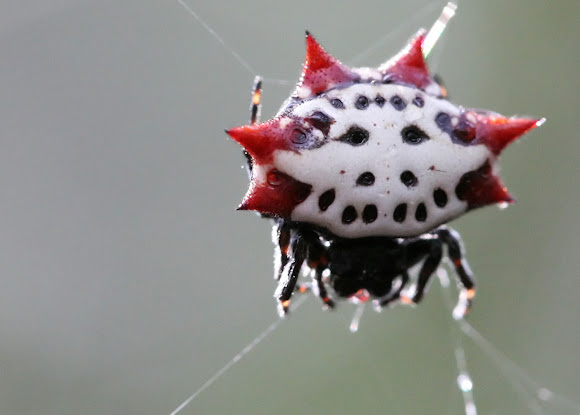
Spiny Butt aka Spiny Orb Weaver

Here is a post I forgot to publish earlier this week!

When I got back from Florida, one of my friends asked me what was the coolest spider I found. I quickly answered the "spiny butt spider." She did not look impressed at the name we had given it, so I explained that it had a spiny butt and was cool and had a really circular web! She still did not look very impressed. I decided to do more research and here is what I found out:

The spiders we collected in Florida are from a genus of spider called Gasteracantha or by the common name "spiny orb-weaver" (which is not very different from what we were calling them!). They are smaller than most other orb weaver spiders and can reach sizes of up to about 33mm. The bite of a spiny orb weaver is harmless to humans and they are considered a nuisance only when the build their webs in a heavily populated location. These spiders also generally have a brightly hued abdomen (white, yellow, and orange are common). The most distinguishing feature of the spiny orb weaver are the six spines poking out of its back.


The different colors of the spiny orb weaver

Another colloquial name for the spiny orb weaver is the "crab spider" since its abdomen looks much like the shell of a crab. However, this name is misleading since it is distantly related to the crab spider family Thomisidoe. The orb weaver also spins a distinctive flat, round shaped webs in shrubs and trees.


Web of a Gasteracantha cancriformis 


The most common species of spiny orb weaver is Gasteracantha cancriformis and this is the species we found in Florida. This species is common in the United States along the southeast coast as well as parts of California.


I now feel very informed about the spiny orb weaver! 

Here is a really dramatic (but not well informed) spiny orb weaver video:
http://www.youtube.com/watch?v=veXlzQk9bUA


Monday, November 5, 2012

Don't Mess with Moose Botflies

Here's a command:

Maybe you're a Bing enthusiast, or you're still into Ask Jeeves! I, for one, do not mind the monopoly that is Google over the internet. Whatever the case, go to your usual search bar and type in "moose botflies." You will find a slew of unpleasant article titles, such as

"Swedish Insects Shoot Larvae Into Victim's Eyes"

and

"Fly shot maggots into woman's eye"

Unpleasant? Yeah.

Moose bot flies fall into the larger category of nose and pharyngeal bot flies, which are obligate parasites whose larvae inhabit the nasal, pharyngeal and throat cavities of various mammals. Though they come in several different host-specific species, ranging from cervids (deer) to horse to sheep to caribuou, their parasitic effects on mammals are huge. Mammals that are parasitized by these nose or pharyngeal botflies tend to be heavily infected, and have high mortality rates. However, in some cases, the larval population inhabiting the host is small, and does minimal damage to the host.

The moose botfly, or Cephenemyia ulrichii, sometimes also called an elk botfly or moose nose botfly or moose throat botfly, enters its mammalian reservoir as a third instar. After mating, the adult female moose botfly seeks a host for her offspring. She usually looks for the mucosal insides of moose and other cervid pharyngeal passages. When she finds the target for her already hatched larvae, she shoots the larvae at the host animal's nostrils. The larvae then travel into the nose as they feed on the mucus. From there, the larvae wriggle down to the throat where they reach their third stage of development.

Sometimes, humans are the unlucky targets of female moose botflies, and they shoot their larvae into the eyes of humans who are casually strolling in the woods. Swedish scientists suppose that, when this happens, the female botflies mistake human eyes for the moose nostrils. The sensation has been described as the feeling one gets when "slapped in the face by a branch." Larvae can only make it to the second stage of development in humans, which means that adult female botflies are making poor life decisions when they choose to shoot larvae in our eyes. But we should still know to watch out--pain and conjunctivitis (eye infection) are likely to result from attacks by these guys.

Weirdly, I could not find a video of a moose botfly shooting larvae into a host's nostrils. Someone's gotta film that so I could watch it and send it to you!

So the Beetle Bris Happened

It ended up being a celebration of the entire life narrative of beetles, from the beginning (the circumcision) to the coming-of-age into manhood (the bar-mitzvah) to the ending (the death of poor Dolph). We opened with some opening words honoring the life of Dolph and Flo Rida (the weevil beetle's name). There was much to be learned from these two beetles, especially for anyone who wants to be a mother or father someday. You see, I actually tried to kill Flo Rida when I found him. That's right... when we were in the lab at Archbold Biological Reserve, I put him in the kill jar for my collection, even though he was strong and alive and well. During his stay in the kill jar, a series of negotiations with other students who were vying for my live ox beetle Dolph had made me realize the high premium placed on live large black beetles as pets. Once I realized their high trade value I decided I wanted Flo Rida alive. After 20 minutes in a freshly charged ethyl acetate container, I was lucky that this strong beetle was not dead. And I removed him from the kill jar, and such is how the story of Flo Rida began.

On the other hand, I took full interest in the life of Dolph, a beautifully 3-horned ox beetle I found just a few minutes before Flo Rida. When I encountered Dolph, I had no doubts about my commitment to making his life comfortable. I would train him for combat against the other ox beetles in the class; I would fan his exoskeleton whenever he was overheated; I would clean his bristle-like tarsals with my toothbrush. I even gave him the name of a real-life Adonis (god of beauty and desire), after Dolph Lundgren--the Sweden-born model, actor, drummer, karate national champion, and current pentathlete coach, who, during his youth, was awarded a Fulbright scholarship to study chemical engineering at MIT, but terminated his academic pursuits for love of a woman for whom he served as a bodyguard. In Rocky IV, Lundgren played the final Russian contender against Rocky, and is known to have said "I must break you."

Image Source: http://thecryptojournalist.files.wordpress.com/2010/10/dolph-lundgren1.jpeg

Now you see how delusional I might have been about the greatness of my ox beetle, especially relative to my weevil beetle, for whom I did not bother to think of a name until I had to for his bris. I ultimately named the weevil beetle Flo Rida, because I found him in Florida, and "Flo Rida" is the name of a well-known rapper. Makes sense.

The irony is, despite my investment in Dolph's life, he died almost right away. Flo Rida, whom I tried to kill, continues to thrive and be lively. Perhaps this is some higher force's punishment--I did not treat my children equally, and I am paying the price with Dolph's life. This may or may not have something to do with the fact that ox beetles are only active until November. But I think it is more the fact that I treated my two children unequally, and am being paid for my failings as the primary care person of these beetles.

So, the beetle bris began with an account of the two beetles. I talked about how and where I found them, and the lessons I learned as a mother. Talking about Dolph was emotional; he had only just died on Thursday, and his precious life was still an emotionally vivid memory to which I was holding tightly. It was followed by our stand-in rabbi, who said many prayers in Hebrew. The atmosphere was complete: there was an empty chair in the room, traditionally set aside for the prophet Elijah to oversee the proceedings and ensure the continuation of the ceremony; the mirror was covered because, during shiva (the period when people mourn a loved one's death), you are not to care about your appearance, and you are not to look at a representation of a human during prayer--to direct our thoughts away from God during prayer is considered idolatrous. There was a hora--complete with an inner as well as an outer circle! We unfortunately lacked a minyan--the quorum of 10 post-bar-mitzvahed men required for religious ceremony--but, otherwise, it was pretty legit.

There was, ultimately, no circumcision, no snipping. We did not know of any professional who would perform the operation without hurting Flo Rida, and we weren't exactly sure of the beetle equivalent of circumcision. Cut its horns? Its antennae? After all, the female is the bearer of the ovipositor. Since we were uninformed, we did not snip.

I think it's time to close. If anyone wishes to honor the life of Dolph, know that he will be found pinned to perfection in my collection. I may even polish his exoskeleton. If you would like to play with Flo Rida, he can be found in his home in my Archbold lunch box. And, finally, Mazel Tov to Flo Rida, who is now a man!

Happy Monday,
Chelsea

Sunday, November 4, 2012

A Great Mentor

A friend of mine and alumnus of this course graduated in 2011, but still has fond memories of the Florida trip, and certain mentors in particular...Indeed, as some of you have already seen, she emailed me one of the most glorious photo mashups known to entomologists:

I can take no credit for this photo, but I think that in terms of the knowledge that Ray has shared with us, this quote only begins to pay homage:


ORay-Wan is a great mentor; as wise as Master Wells, and as powerful as Masters Harrington and Morley."
―Anakin Skywalker, to Padme Amidala


And given the incredibly detailed wealth of information that Ray has already imparted, from spur-throated Orthopteran identification to Hemipteran life history secrets and Phasmatodea dissection techniques, I believe Qui-Gonn's advice now instead applies to us:

You still have much to learn, my young apprentice."
―Qui-Gon Jinn


Thanks for everything Ray!

Saturday, November 3, 2012

Hawthorn: A Bicentennial Home for Persevering Galls

Hey guys! I've been slow on the blogo-sphere, but after missing Dolph's life narrative on Friday, I realized I needed to rejoin the insect party (...a lek?).

Acromyrmex versicolor  lek (via Alex Wild Photography)

Anyway, my housemate awoke me early on Saturday morning and told me to COME OUTSIDE! He was working on a tree planting with URI in the front yard, and wanted my thoughts.

(Urban Resources Initiative does this for free-it's actually pretty awesome. There's a city link here for tree-requesting, and via the URI website. Tell your off-campus tree-lacking friends! Or your home city!)
The group I met on Saturday included an FES student and three cheerful local high school students.


Whaaaa--? It was early and I had been up late! What could ever convince me to venture into the chilly air? And then my housemate mentioned galls. Something was up with our free tree, and the group needed counseling from their resident EEB251L groupie--ahhh, dear friends, suddenly I was feeling spritely.

[Yes, this is a gall story. As Val likes to tell me, I am a 'woman obsessed.' I fell in love with the idea of parasitic endophagy years ago. It was the first time I pulled a horn worm caterpillar off of a tomato plant and realized that 'lucky' fellow wouldn't be thrown to the chickens; he was already being devoured...from the inside out. I wanted that one to survive to make more wasps! To kill more caterpillars!! To save my tomato plants! Wow! Anyway, the logical next step is galls...I think. Okay, on with the tale.]

The hawthorn tree had a few galls on it, and they were all different. Yay! The URI folks didn't mind a (s)midge (<--get it?) when I asked to take the galls. I assured them that those particular, individual insects would never infest those branches again!

Most websites that mentioned Hawthorn specific endophagous insects bring up Resseliella crataegi, and I know that you'll all be as pleased as me to learn that Resseliella is a genus in the family Cecidomyiidae (source). If you check back to my very first blog post, this is the same family as those small orange larvae that D. Wagner helped me identify inside the leaves at Great Mountain. So those guys are Dipterans.

One really amazing resource I found lists hawthorn galls from 1927, all in the genus Eriophyes--they were discovered in West Sussex! (Check it out: On the Gall Mites of Sussex "The writer is indebted to Mr. W. Fowle for continued assistance in obtaining many of the specimens." Species IDs are in the 1890s and 1910s.). Eriophyidae is a cool family of gall arthropods, because as acari they're arachnids, and because they've got the galls like alien tentacles:
(source
Mr. Fowle's specimens seem to be testament to changing phylogenies and naming conventions that evolve as rapidly as the tiny parasitic munchers themselves. Googling Eriophyes albespine produced a third hit simply titled "Mystery Words." The genus has lasted, however, and it is nice to think that my enthusiasm has been shared for at least a century!

This has gotten quite lengthy, so I'll save you my other Hawthorn-related narrative for next time, and I haven't yet fully identified my specimens. In the meantime, feel free to stop by the front of my house any time and check out our tree--maybe I missed a gall or two; it's not as pin-able as an Orthopteran, but we can all use Cecidomyiidae!

Friday, November 2, 2012

Colorful Lobsters

Lookie!

Last week, a rarely occurring lobster--one with a color combination only seen in about 1 in 50 million lobsters--was caught by a fishermen off the Beverly coast of Massachusetts. It was a female weighing in at one-pound whose coloring was split down the midline of her body--on the right she was colored orange, and on the left she was colored a dark brownish. Just in time for Halloween!


Most lobster shells are colored red, yellow, or blue.  Lobsters eat shrimp, algae, and other sea creatures that contain cartenoid pigment, which colors the lobsters’ skin red (If they don’t eat the pigment, they remain white). When the pigment is transferred to a lobster’s shell, proteins bind to it, turning it blue. As more and more pigment-protein complexes start to stack up in the shell, they bend and turn a yellow color. The most typical American lobster's shell is a medley of these pigments, resulting in a dark bluish green to greenish brown, with their body and claws being more red, and their legs being more green, as such:

Image source: https://theterramarproject.org/admin/uploads/image/width/639/height/453/file/species:93589_orig.jpeg

Another form of blue is caused by a genetic mutation seen in about 1 in every 2 million lobsters--this is a "true blue" because its coloring is intrinsic, and not environmentally impacted or food-dependent. These lobsters produce an excessive amount of a protein that combines with a red carotenoid molecule known as astaxanthin to form a blue complex known as crustacyanin, giving the lobster its blue color. 

Image source: http://en.wikipedia.org/wiki/File:Blue_lobster_02.jpg

Back to split lobsters--researchers suppose that the fact that these lobsters have split coloring because of a developmental malfunction resulting in a half-male, half-female specimen. Bob Bayer, the animal and veterinary sciences director at the Lobster Institute through the University of Maine, writes in an email that he’s “seen quite a few of these mixed-colored lobsters (see "A Lobster Tale" here for more info). They are all hermaphrodites.” Further, from a Darwinian standpoint, it's likely that these types of lobsters--though hailed as exotic and beautiful in the human world--are less able to blend into their surroundings, and selected against in nature. 

So, as much as we'd like to think that those bright red lobsters we see on our dinner plates are found like that in nature, I think we'll have to settle for the fact that we only get these in the kitchen. No matter the intrinsic properties of the lobster, it will still turn bright red once you cook it because heat breaks the proteins and frees the red carotenoid pigment.

...But wait! You can actually find bright red lobsters in nature. They are just rare, occurring about once in 10 million.

Now, since I don't feel like writing more paragraphs, I'll just share with you three other kinds of rare lobsters in list form. There's:

The yellow lobster, occurring about once in every 30 million lobsters

Image source: http://assets.nydailynews.com/polopoly_fs/1.205352!/img/httpImage/image.jpg


The "calico" lobster--with a mottled black and orange appearance--also occurring once in every 30 million lobsters

Image source: http://www.blogcdn.com/www.slashfood.com/media/2005/08/Calico%20Lobster.jpg


And, the most rare, the albino lobster, lacking all pigmentation--occurring once in every 100 million lobsters.
Image source: http://www.albinolobster.com/wp-content/uploads/2011/04/20080211-la-langosta-blanca-the-white-lobster.jpg


Woo! An informative blog post, for once. Hooray! But it's not exactly about terrestrial arthropods... sorry everyone.

Now come to my beetle bris/funeral at 7pm tonight (Dolph died yesterday--may he rest in peace).
-Chelsea

Everyone needs to click this link!

It's a David, devouring a chocolate bundt cake to soothe his unsteady emotions surrounding a weak collection day. I made a gif. Lol.

-Chel"what am I doing with my life?"sea